

Notes on Version Changes (v1 vs. v2)
This part of the documentation has been updated to describe the updated wallet setup for Pontus-X (v1) which now includes a simple wallet file configuration flow for Pontus-X portals, but also to include updates for Ocean Enterprise stack (v2) introduced in 2026.
With v2, based on Ocean Enterprise, a dual wallet process has been introduced which includes:
- a participant agent wallet holding SECP256k1 keys for signing transactions and interacting with smart contracts and Ocean Enterprise components, such as the connector
- a SSI wallet holding Verifiable Credentials and RSA keys for the signature of Verifiable Credentials and Presentations to engage a with Policy Decision Point and to sign catalogue items in the updated catalogue components.
When using Pontus-X v1 only the wallet file setup is relevant.
When using Ocean Enterprise v2 the wallet file setup and the SSI wallet are relevant during the setup.
Wallet File Setup (v1 and v2)
To get started as a participant in the ecosystem you need to take control over your private key(s) and insert it(them) in a wallet. The wallet file allows a participant to load private keys for signatures and smart contract interactions into a participant agent, e.g. a Portal, to perform interactions, such a signing and submitting transactions.
You will either use your private SECP256K1 keys you have created yourself using an offline wallet file generator OR use a set of SECP256K1 keys you created during guided onboarding with the Fast Track Application.
Your private key SECP256K1 will look like this (just an example, not to be used!):
0d9619d1702c7a4ff89ecf37201TEST2f0d124ca503a61c5f3a60e0451236365
From this private key an account address will be derived, e.g.
0x29080D654eFD6AC00f8b26F4741E82CD0c2C0778
which will be a public and unique identifier of the controlled account.
The wallet file is an AES-encrypted JSON file holding your private key, protected with a password.
{
"address": "29080D654eFD6AC00f8b26F4741E82CD0c2C0778",
"id": "16646b51-1b7e-4bb8-9d7a-6deb355e34a1",
"version": 3,
"crypto": {
"cipher": "aes-128-ctr",
"cipherparams": {
"iv": "cb6539bdcc14e8d7dbc4124eb001fad2"
},
"ciphertext": "207281e6e4387ce9f1e1dd6ad09ed5020776f39c94d0dec1e6bc7368247be715",
"kdf": "scrypt",
"kdfparams": {
"salt": "0cfe5cbc91124c7b55e0b730c8c79503b3568e7f81c488df32cbbd04406e5e45",
"n": 131072,
"dklen": 32,
"p": 1,
"r": 8
},
"mac": "ddb4c4573c50ccbad79b49e1d66736c7d71ffc7a116192fd628f3bfcfd4c28aa"
}
}Some important notes before you continue:
- This private key controls your identity in the ecosystem, create a secure offline backup.
- Do not share it with anybody outside your organization , don't store it in the cloud.
- If you lose control over your private key please inform us immediately so that the Pontus-X federators can denylist it for the network and inform potential other data space authorities about it.
- You are not allowed to store any personal information on the network , i.e., names, or e-mail addresses when publishing own service offerings on the network.
The wallet file can also be imported into MetaMask, a commonly used Web3 wallet.
Wallet File Usage (v1 and v2)
When opening your participant agent, e.g. a data space portal, you are prompted to configure the participant agent so that it represents you. This is done by loading your private key into the participant agent with the wallet file.
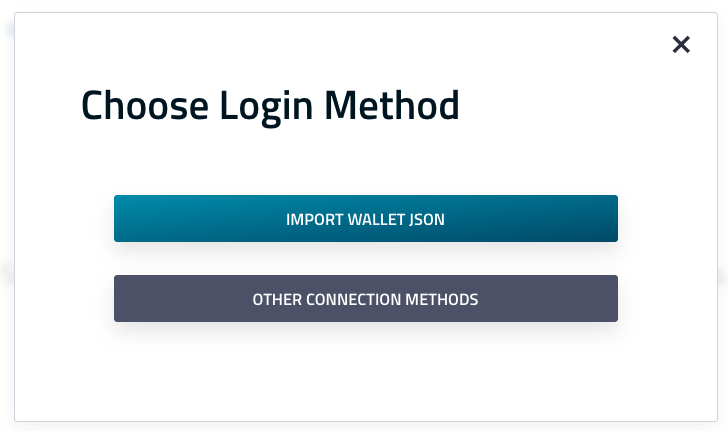
Screenshot of the wallet selection in a v1 data space portal.
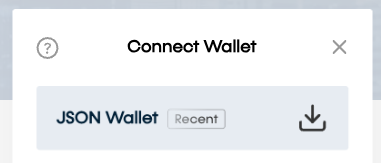
Screenshot of the wallet selection in a v2 data space portal.
When selecting the wallet file and uploading it into the participant agent you will be prompted to insert the password to allow the decryption process.
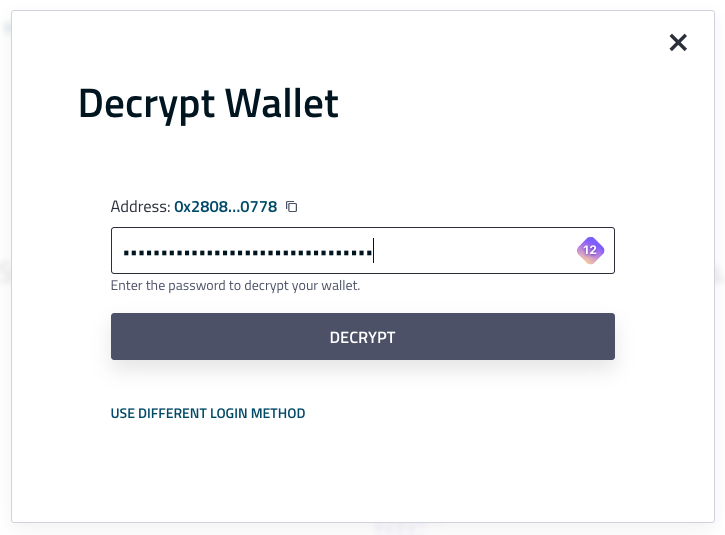
Screenshot of the wallet decryption dialogue in a v1 data space portal.
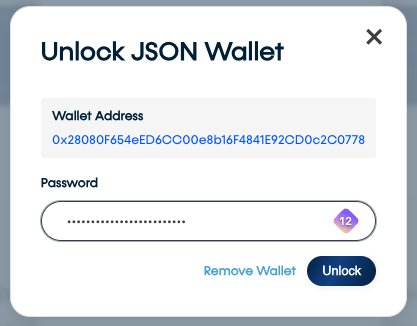
Screenshot of the wallet decrytion dialogue in a v2 data space portal.
Once the wallet file has been successfully decrypted and imported into the participant agent a short notification will appear and the public address can be verified through the indicator in the upper right corner of the interface.
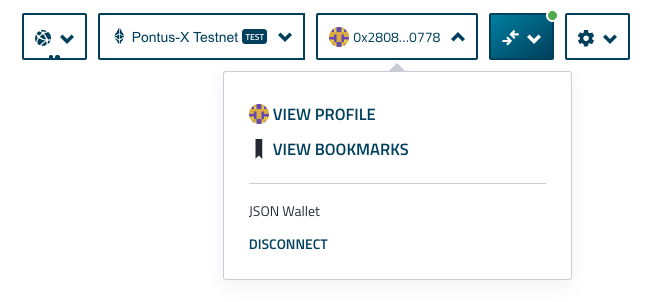
Screenshot of the Account Menu in a v1 data space portal.
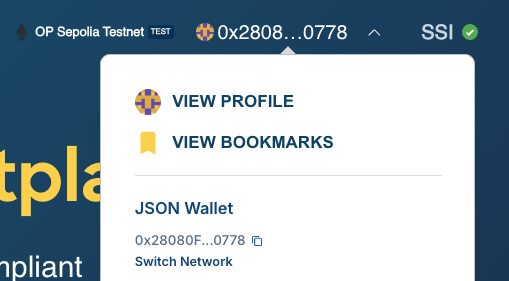
Screenshot of the Account Menu in a v2 data space portal.
Funding the Wallet for Transactions (v1 and v2)
To be able to perform writing transactions to the data space ecosystem and to conduct payments the account needs to be funded. In the development and testing systems this is done through a Faucet. Once connected to a Pontus-X Portal with a faucet integration an organization can request initial and additional funding through the faucet.
In the v1 network (Pontus-X Devnet and Testnet) fees will be covered through EURAU fee tokens and payments through EURAU payment tokens to simulate the fee and payment structures of a production environment, but without real economic value.
In the v2 network (Optimism Sepolia) fees will be covered through ETH and EURAU payment tokens to simulate the fee and payment structures of a production environment, but without real economic value.
In the production implementation fees can be abstracted and payments can either be performed via e-money or via alternative payment channels.
Connecting the SSI Wallet with the Participant Agent (v2 only)
In the v2 participant agent the user will be prompted to connect to an SSI wallet. For the connection the wallet file private key, just loaded into the participant agent, will be used.
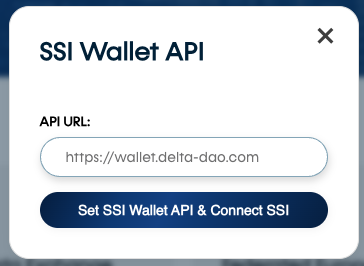
Screenshot of the SSI wallet connection dialogue in a v2 data space portal.
Here you configure your own SSI wallet which has been setup already and contains the necessary private keys, verifiable credentials and is linked to at least one DID
. The setup of such a wallet (not the deployment) is discussed in the next chapter.SSI Wallet Setup (v2 only)
To be described after public release of the v2 stack.
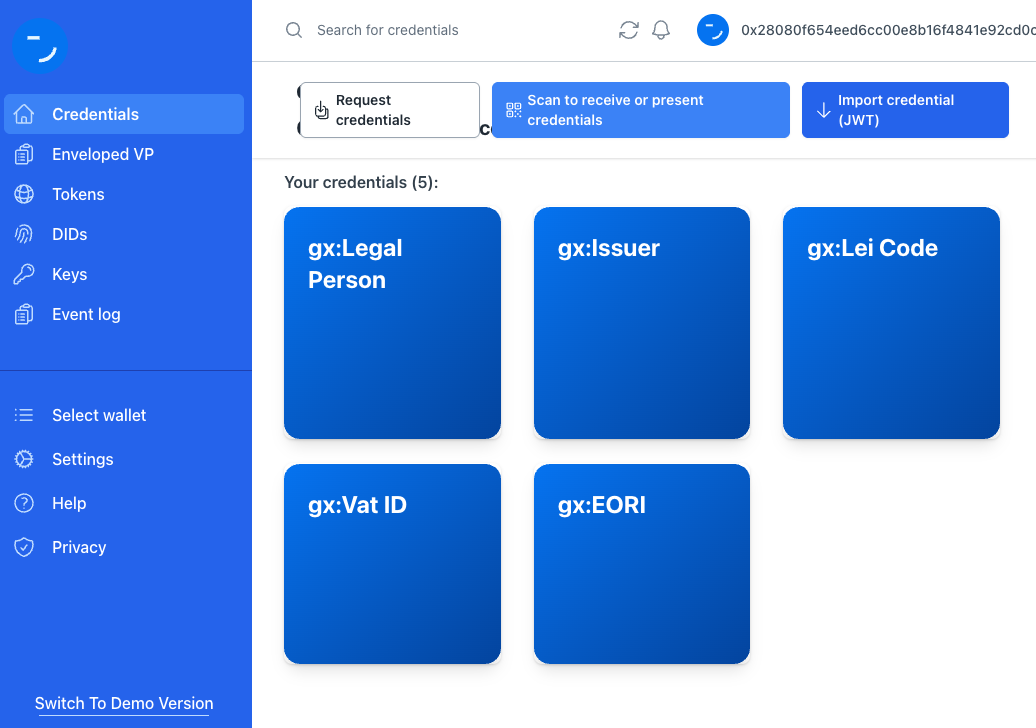
Screenshot of walt.id wallet as SSI wallet in the v2 stack.